Just Compensation in North Carolina – Determining How Much Your Eminent Domain Case Is Worth
When the government or a utility company operating under governmental authority decides to take your property under the power of eminent domain, the law states that fair compensation, known as “just compensation,” must be offered.
But in eminent domain, just compensation depends on more than a simple appraisal. Determining what constitutes “just compensation” is often at the heart of eminent domain cases.
Just compensation is typically defined as the impact, or loss, to the fair market value of your property. “Fair market value” is defined as the highest price that a seller could get for a property from a knowledgeable buyer in a voluntary transaction (unlike eminent domain).
In other words, fair market value and the value of your land is a matter of opinion – and often negotiable. Before you agree to any NCDOT offer, get a free case evaluation.
Real-World Compensation Examples¹
Example 1: Residential Property – The NCDOT took 33% of a residential property in Wake County for construction of a new elevated interstate and off-ramp. The DOT appraisal did not account for damage to the home’s value resulting from the project or for the increase in noise resulting from the lost tree buffer. Our analysis indicated that over 150 feet of tree buffer would be taken, and that the project’s noise reduction features would not benefit our client’s property. Our careful work helped the homeowners receive more than double the NCDOT initial offer.¹
Example 2: Commercial Property – The NCDOT offered a Wilmington fast food business owner $38,000 for a utility easement. Our research showed that the easement would take at least 11 parking spaces and impact driveways as well. The government’s stance was that the impacts of this project were largely temporary, and that the owner could continue using these areas once the project was finished. This view overlooked the full impact of permanent property rights the government was taking now but not actively planning to use. We took the case to trial, and a jury awarded our client $400,000 – more than 10 times the original offer.¹
Example 3: Agricultural Land – When the NCDOT acquired 13+ acres of our client’s farmland, the taking bisected the land. While the NCDOT did include compensation for the leftover land on both sides of the project, its offer fell short of our client’s expectations. We had an independent appraisal done which showed a different “Highest and Best Use” for the property, resulting in significant damages that helped us negotiate $400,000+ more than the State’s initial offer.¹
What Factors Determine Your Eminent Domain Compensation?
The government typically wants to get your property for the lowest amount possible. But we’ve seen the government fail again and again to consider all of the complex factors that determine your property’s true value – and how much compensation you may be owed – including:1
Your property’s highest and best use – the highest value of the land, even if that’s not how the land is currently being used
Damages to the remainder of your land – the reduction in value of your remaining property if the government takes just a piece of it
Business Reestablishment in Eminent Domain Cases
Can I recover compensation for business losses or goodwill if only part of my commercial property is taken?
No. Other than the value of acquired land, easements, and damages to the remainder, owners may not seek compensation for business-related losses such as lost profits during relocation and going-concern impacts when the taking substantially impairs operations. Independent valuation and expert analysis are often key to establishing which items should be considered in the just compensation.
Costs to reestablish: Expenses required to set up operations at a new location, including build-out, equipment reinstallation, and staff transition costs, may be recoverable under relocation assistance.
Loss of access and visibility: A partial taking that cuts off customer access, removes signage, or reduces the visibility of your property can reduce the value of your remaining property.
Compensation for business properties is among the most contested claims in eminent domain proceedings. Independent valuation and expert analysis are often critical to building a defensible number.
True fair market value –a government appraisal is not always reflective of what a property would be worth on the open market
Relocation expenses– if your property no longer serves its purpose after the taking and you must move, many of those relocation costs may be included in your compensation
Relocation Assistance in North Carolina
Are relocation expenses covered, and which specific costs can NC property owners recover?
Yes, generally. Eligible relocation benefits may include moving costs, reestablishment expenses for businesses, search costs for replacement sites, and certain increased rent or mortgage interest differentials under the Uniform Relocation Act and NC policies. Document all expenses and seek eligibility determinations early.
Eligible costs may include:
Moving expenses: Actual, reasonable costs to move your personal property, or a fixed payment based on room count for residential properties
Replacement housing payment: A supplement to help cover the difference between your current home’s value and the cost of a comparable replacement home in the area
Rent differential payments: If you are a tenant, assistance covering the increased rent cost of a comparable replacement unit for up to 42 months
Search costs: Reimbursement for reasonable expenses incurred while searching for a replacement property, up to the limit set under URA
Business reestablishment expenses: If you operate a business, farm, or nonprofit from the displaced property, you may recover costs to reestablish at a new location, up to the applicable cap.
Steps to help protect your potential relocation benefits:
Notify the condemning agency of your intent to file a relocation claim before you move.
Keep all receipts, invoices, and records related to your move.
Request a written eligibility determination from the agency’s relocation coordinator.
Do not accept the first relocation estimate without reviewing it with your attorney.
Relocation benefits are frequently underutilized because property owners do not know what they may be entitled to. An attorney can help you seek everything available to you.
A qualified eminent domain lawyer can help you fight for just compensation by working with experts as needed, such as:
Appraisers
Land planners
Civil engineers
Real estate agents
Surveyors
And more
These experts can offer an independent evaluation of your property and seek out evidence to support your position that you deserve more compensation.
At the NC Eminent Domain Law Firm, we have long-term relationships with experts from each of these fields and more to help us build our clients’ cases.
How does the condemning authority determine what it offers a property owner?
The condemner – let’s say it is the North Carolina Department of Transportation (NCDOT) – will have an appraiser analyze the property being taken and base its compensation offer on the result. However, that offer may not reflect fair market value at all.
In appraisals, multiple methods are used by appraisers depending on the property. Different methods are used depending on the circumstances – and the circumstances of an eminent domain appraisal can get very tricky.
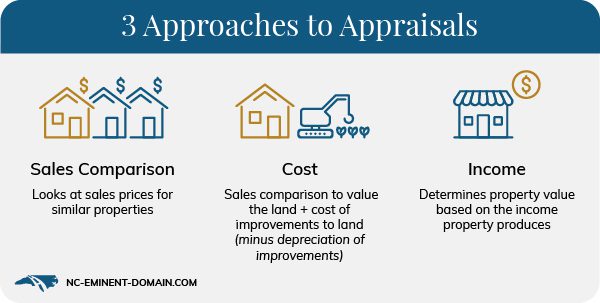
Appraisers use three primary methods to determine just compensation in eminent domain cases. The method selected can significantly affect how much you are offered if you’re impacted:
Sales Comparison Approach
By looking at other similar properties’ sale prices, an appraiser can establish a value for the subject property. This is a common approach to appraising residential properties, but its conclusions may be incomplete in eminent domain cases. The sales comparison approach is also known as the market approach.
Cost Approach
This approach draws on the sales comparison approach to calculate the value of the land, then adds the cost of improvements on the land (minus the depreciation of those improvements) to arrive at a total value.
Income Approach
The income approach – also called the income capitalization approach – determines the value of the property based on the income it produces. There are a number of factors considered, including projected future income, and this kind of appraisal is vital in calculating compensation for takings of commercial and income-producing properties.
With different appraisal methods used for different properties depending on different market conditions, it’s easy to see why just compensation becomes an area of intense negotiation.
Consult with an experienced eminent domain attorney before agreeing to anything to try to ensure you’re not leaving significant money on the negotiating table.
Types of Takings and How They Affect Compensation
Not all eminent domain actions work the same way. The type of taking determines what you can recover and how compensation is calculated.
Physical Takings: A physical taking occurs when the government acquires your property or a portion of it outright. This is the most common form and includes full acquisitions, partial acquisitions, and permanent easements. Compensation is based on the fair market value of the property interest acquired, including any damages to the remaining property.
Regulatory Takings: A regulatory taking occurs when a government regulation restricts the use of your property so severely that it eliminates its economic value, even without physically acquiring it. These claims require legal analysis under both state and federal constitutional standards. Not all regulations constitute a taking, and these cases are evaluated on their specific facts.
Temporary Construction Easements: When a government project requires access to your land for a defined period during construction, you may be asked to grant a temporary construction easement. These entitle you to compensation for the fair rental value of the area during the easement period, as well as any damages caused to the land, crops, drainage, or access during construction.
Determining fair market value for a partial taking
Partial takings, where the government is “only taking a piece” of your property, are the most common types of eminent domain takings. Just compensation for the remaining property is related to the fair market value of the entire property but can get very tricky.
For example, let’s say you have a home or a business on one acre of land. The NCDOT comes along and wants to take 0.1 acres. Not ideal, but not the end of the world – but what if the partial taking makes your existing structures nonconforming with county building codes?
Or let’s say your property has unique features – maybe it has a natural spring or is adjacent to a main road your particular business relies on. How does anyone determine the fair market value of (or just compensation for) your land if there are no similar slivers of property with your unique features that have sold on the market?
And what about the damages caused to the remaining property? If the 0.1 acres taken include your natural spring, that could have a significant impact on the viability and value of your remaining land.
Before you accept any eminent domain compensation offer, get a free case evaluation from an attorney who knows how to challenge government appraisals.
Should I accept the NCDOT’s first offer?
Consult with an experienced eminent domain attorney before agreeing to anything to try to ensure you’re not leaving significant money on the negotiating table. You should almost never accept the government’s first offer.
You should almost never accept the government’s first offer.
How to get the most money from eminent domain?
Getting the most from an eminent domain case can start before you respond to any offer. Key steps may include hiring an expert appraiser with condemnation experience, documenting all damages to any remaining property, accounting for potential relocation costs, and retaining counsel early. The government’s first offer is a starting point, not a final number.
When you are notified that the government wants to take your private property under eminent domain, you may feel compelled to accept the first offer. However, this is not required, may not be in your best interest, and may not equal just compensation.
The basis of the government’s offer will be their appraisal of your property. Mistakes can be made. And you want the appraisal to reflect the unique variables of your land that make it valuable.
Remember, each piece of land is unique. Just because your neighbor’s land isn’t worth much, that doesn’t mean yours isn’t valuable. The appraisal should provide evidence of the highest and best use that you should be compensated for, even if it’s not the use the property historically had.
The appraisal process is not an exact science, and the government is not responsible for prioritizing your best interests. So how do you get fair compensation?
That’s where we come in. We can work with our network of land experts across the state to obtain an appraisal that demonstrates the true value of your property.
Skilled North Carolina eminent domain lawyers
On our powerful team, we have experienced eminent domain lawyers, five of whom previously worked representing the NCDOT. That means we know eminent domain, we know the NCDOT, and we know you’re likely not being offered enough for your property.
To make it easy for you to pursue everything you may be owed, we work on a contingency fee basis. That means we advance all costs of building your eminent domain case and only collect a fee at all if we get you more than what the government offered. The initial offer from the government is always 100% yours to keep. And if we don’t get you more money for your property, you don’t pay us anything. Guaranteed.
Since our firm began, we’ve increased the average initial offer for our clients by 206%…That’s over 3x more!1
You have rights and you are entitled to just compensation for what the government takes – but the government’s appraisal may be seriously undervaluing your property. What’s it really worth?
To discuss your potential eminent domain compensation, call 1-877-393-4990 or contact us online for a free case evaluation.
What Is Not Compensable in an NC Eminent Domain Case?
Understanding what the law does not compensate for is just as important as knowing what it does. In North Carolina eminent domain proceedings, the following items are generally not recoverable:
Sentimental value: The personal, emotional, or historical value you place on your property is not a recognized basis for compensation. Fair market value reflects what a willing buyer would pay, not what the property means to you.
Value created by the government project: If the condemning agency’s project increases the value of your remaining property, that increase may be used to offset a portion of the just compensation award.
Goodwill personal to the owner: Business goodwill is typically not compensable in North Carolina. If the value of a business is tied to the specific skills or reputation of the individual owner rather than the location itself, it is generally not compensable.
Non-monetary impacts: Noise, traffic, inconvenience, or aesthetic harm caused by a project do not typically support a separate compensation claim unless they directly reduce the fair market value of your property.
Speculative future value: Compensation is based on the property’s value on the date of taking, not on what it could be worth in the future.
Knowing these limits can help you focus your claim on compensable items and avoid disputes that delay resolution.
FAQ
Do you have to pay taxes on eminent domain money?
It depends. Compensation for the fair market value of your property may be subject to capital gains tax depending on your cost basis and how long you have owned the property. Relocation payments are generally treated differently and may not be taxable. Because tax treatment varies by situation, consulting a tax professional alongside your eminent domain attorney is strongly recommended.
Are eminent domain cases hard to win?
In NC, the fight is rarely about whether the government can take your property. Courts almost always uphold that right. The real contest is over compensation. Factors like the type of taking, appraisal disputes, damages to the remainder, and available market evidence all shape how far apart the two sides are. Most cases resolve through negotiation rather than trial, but experienced counsel can significantly affect the outcome.
Free Case Evaluation: Find Out What Your Eminent Domain Compensation Should Be
There are only a handful of attorneys in NC who practice eminent domain exclusively, and even fewer with NCDOT experience. We have six. That’s why it’s worth getting in touch with us for a free case evaluation.
Here’s how it works:
1) Tell us about your situation.
2) We research your property as needed, using DOT maps, our own technology, and experience to see the exact effects.
3) We will give you our professional evaluation of your legal situation and recommend next steps. This evaluation is free, and there’s no pressure or obligation to hire us after.
But please don’t wait to act. Waiting can hurt your case, and the cost is the same: free.

 1-877-393-4990

 1-877-393-4990